|
HOME > Useful Information > Sightseeing Spots and Specialty Products > Sights and Tourist Facility Information
Sights and Tourist Facility Information
Konotaki Waterfall (Rainbow Falls)
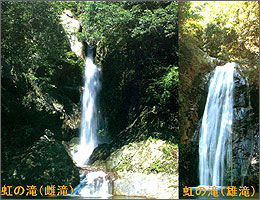
Konotaki Waterfall is located in Komino on the border of Miki Town and Shinoe-cho, Takamatsu City. It is actually two waterfalls male and female. The male waterfall is also called "Kamoshika" or Antelope Waterfall. The female waterfall is also called "Choshi" or Sake Bottle Waterfall, due to its similar shape. The male waterfall is about 11m in height and 5m wide. The female waterfall is about 8m in height and 6m wide. It is not a large waterfall but the volume of water is abundant. When the sunlight hits the water, you can see beautiful rainbows which is where it got its name. This waterfall has been selected as one of "Kagawa's Top 100 Scenic Sites". It is best viewed at the beginning of summer surrounded with beautiful green leaves or in autumn surrounded with hues of red, orange and yellow leaves. It can be enjoyed in all seasons hiking, camping, fishing and picking wild plants. Konotaki Waterfall Campground has bungalows, making it a popular summer destination for families.
Taiko Forest (Ancient Forest)
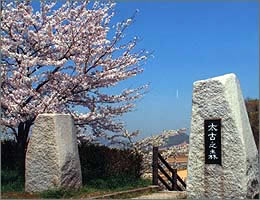
This forest is on the bank of "Yamadaiji Pond"; one of "Kagawa's Top 100 Scenic Sites". This forest has many metasequoia trees (the symbol of Miki-Town). The forest was created so that people could interact with and appreciate nature. The forest is on a peninsula on the Eastern side of Yamadaiji Pond. It is 3.8hectares. There are 2,700 metasequioa trees planted in the forest. These trees are living fossils.
Area / 37.713 square meters
Metasequioa
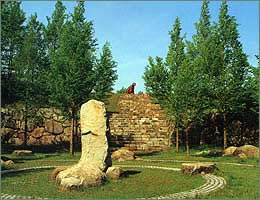
The tree was named for a fossil which Dr. Shigeru Miki discovered from a stratum dating to the Tertiary in 1941. He was a botanist from Kaniwa, Miki Town. Four years later, it was proved that the metasequoia had flourished in the outback of Szechwan Province, China as a sacred tree, reinforcing Dr. Miki's findings. As a result it became well-known and he received praise from many people all over the world. The ancient forest is composed of a green hill, view-point hill, commemoration hill and a hiking course, linking all the areas. Visitors can enjoy what the forest has to offer year-round. Children will also enjoy the playground where they can play on dinosaurs (Tyrannosaurus and Triceratops).
Area / 37.713 square meters
Water Avenue
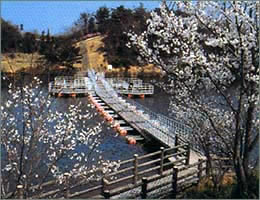
To connect the Ancient Forest and the sports park, a floating bridge "Water Avenue" was built on Yamadaiji Pond. A steel frame bridge rests on 40 floats with a boarded walkway. It is 1.5m wide and 72m in length. There are four "Dejima" (islands) in the center so you can take a rest on the water.
Mount Shirayama
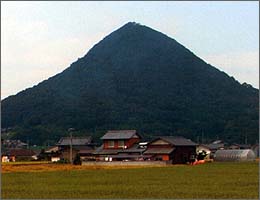
Mt. Shirayama is the symbol of Miki Town. It is called eastern Sanuki (the old name for Kagawa) Fuji because of its' resemblance to Mt. Fuji. The western Sanuki Fuji is Mt. Ino. At first glance it looks like a rice-ball and imbibes a peaceful feeling in those that see it. At 203m, the scenery around the foot of the mountain is home to many historical sites and remains beautiful in all seasons. It is said if you throw a coin into a deep hole in a rock on the summit, you will be able to hear it for a long time. Visitors will find Ryuo Shrine at the summit and Shirayama Shrine at the foot. A long time ago the mountain was worshiped by farmers since it was considered to be related to rain. Now, it is a popular early morning hiking spot. It will always be a popular symbol of the town.
Tomb of Shizukagozen
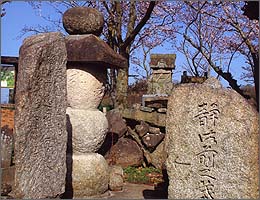
Surrounded by a grove of old pine trees, "Shizuka-Yakushi-An" sits on the edge of Kaji Pond in Nakadai, Ido, Miki Town. There is a five-tier-stone grave marker showing that it is the tomb of Shizuka Gozen who was loved by Minamotono Yoshitsune.
The exact years of Shizuka's birth and death are unknown. It is said that she was a beautiful and skilled Shirabyoshi dancer (a female dancer) and was the daughter of Iso no Zenshi. In 1185, when Yoshitsune divided from Yoritomo, he was enjoying himself in Rokujo Horikawa Tei in Kyoto, and met Shizuka there. What followed became a famous story - Shizuka separated from Yoshitsune in Yoshino that year. In 1186, she was caught and sent to Kamakura where Yoritomo questioned her about the location of Yoshitsune, but she insisted that she had no idea. She danced to show her love for Yoshitsune in a corridor in Hachimangu shrine in Shizuoka on April 8th. The legend continues that Shizuka came to Sanuki (the old name for Kagawa), and attained enlightenment at Nagaoji Temple, became a nun, and then passed away here. There is another tomb at Ganshoji Temple (Miki Town). According to the legend, Shizuka came to Sanuki because her mother Iso no Zenshi was from Nibu, Ochi-Town (current Higashi-Kagawa City).
Last Updated: February 7, 2011
|